
The Six-Fingered Handshake
Why AI-Generated Content is Unmaking Masonic Credibility

Today I am honored to publish this guest post by Worshipful Brother Nicholas Bell.
Nicholas Bell currently serves as Worshipful Master of Verity Lodge No. 59 in Kent, Washington, and Worthy Patron of Naomi Chapter No. 13, Order of the Eastern Star, in Puyallup, Washington. He is a member of the Grand Lodge of Washington's Masonic Research and Education Committee. His other writings and essays can be found on his Substack at Frater DT.
This is an important post. Warning us, as leaders of our Lodges to the reputational damage inauthentic online content has on our ability to connect with men who are seeking more information about Freemasonry.
I urge you to strongly consider what our Brother writes here.
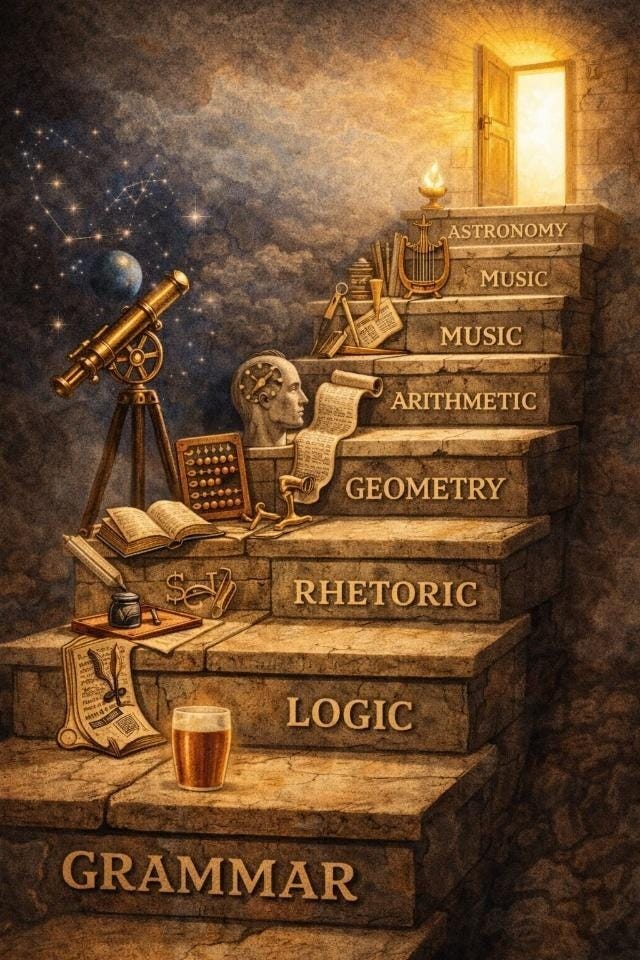
“The excellence of every art is its intensity, capable of making all disagreeables evaporate.” - John Keats, letter to George and Tom Keats, 21 December 1817
Lodges recruit with their standards. Every piece of material it publishes, every image it posts to social media, every flyer it circulates for a stated communication dinner or a charity breakfast carries an implicit claim about what kind of institution stands behind it. Right now, across the digital landscape of American Freemasonry, that implicit claim is being made by machines that cannot understand what they are claiming.
This pattern has become familiar enough to function as its own genre. A lodge secretary needs a graphic for an upcoming event. He opens an AI image generator, types a prompt involving aprons and columns and candlelight, and within seconds receives something that looks, at first glance, like a promotional image. He posts it to the lodge Facebook page with the event details in the caption and moves on to the next item on his list, satisfied that the task is done. He has filled the digital space and, in his own estimation, he has modernized.
His posted image features six-fingered hands clasped in a grip that corresponds to no degree in any recognized jurisdiction. The Square and Compasses are rendered asymmetrically, fused to geometric shapes that hold no ritualistic or historical meaning. The text across the bottom appears to have been transliterated from a language that does not exist. The lodge room depicted behind the figures is a soaring cathedral interior with vaulted ceilings and golden light pouring through stained glass. This bears no resemblance to the actual lodge room, which is a second-floor hall above a hardware store with fluorescent lighting and folding chairs. Members of the Freemasonry subreddit have described these outputs with the precision they deserve, promotional flyers featuring chefs with extra fingers, syrup floating in midair, and atmospheres resembling, in one commenter’s memorable phrasing, “a haunted IHOP from another dimension.”¹ In a separate thread, a lodge secretary admitted the core difficulty, he could not find acceptable free stock imagery specifically for or about Freemasonry, reported that AI tools were producing inadequate results, and suggested what should have been the starting point all along which was building a volunteer photographer pool to create real visual assets.²
Both are anecdotal sources, drawn from forums rather than peer-reviewed journals. They are cited here because they demonstrate something academic literature cannot capture on its own: this problem is already being recognized as a quality failure from within the fraternity’s own digital communities. Brothers posting these critiques understand, instinctively if not analytically, that something has gone wrong with how the Craft presents itself to the world.
Context explains the temptation. U.S. Masonic membership peaked at roughly four million in 1960 and has fallen to approximately 869,000 as of 2023, according to the Masonic Service Association of North America, which consolidates national totals and reports that figure as the lowest in its published table, continuing a multi-year downward slope from 2019 onward.³ Jurisdiction-level data shows the same trajectory across many states with differing magnitudes.³ The age pyramid skews heavily toward members over fifty-five. The fraternity is, in demographic terms, missing the bulk of an entire generation. Under that kind of pressure the promise of frictionless content creation carries a seductive logic, if we can just get something out there, quickly, we can reach the men we need to reach. Canva launched its “Magic Studio” suite positioned as “all the power of AI, all in one place,” explicitly targeting non-designers with easy generation features.⁴ Adobe markets an AI flyer generator inside Adobe Express that produces template options from simple prompts, presented to avoid starting from scratch.⁵ Stock platforms have integrated AI generation and AI editing as routine pipeline features, placing synthetic visuals in the same shopping aisle as conventional photography.⁶ The tools are free or cheap, the output is instant, and the friction is gone. That friction, though, was doing something. That friction was the standard.
The Front Door
Lodges that post AI-generated visuals are making a category error about what digital communication is. Men who came into the fraternity before smartphones, Instagram, and algorithmic feeds, tend to think of the lodge’s online presence as a convenience, a digital extension of the trestle board mailed to members’ homes. That mental model has been obsolete for years.
For most potential candidates in 2026, your Instagram page, your Facebook feed, and your website header constitute your lodge in its entirety. They are the whole of your organization’s public identity. A young man searching “Freemasons near me” will encounter your digital presence before he encounters your Tyler, and what he sees in that first five seconds will determine whether he ever makes it to the second encounter. He will take the marketing at face value because every other organization competing for his time and attention has taught him that the quality of the presentation reflects the quality of the institution behind it.
The Grand Lodge of California recognized this explicitly when it profiled La Jolla Lodge No. 518 in April 2021.⁷ That lodge built one of the most successful social media operations in American Freemasonry, accumulating over 8,000 Instagram followers (as of 2026), and its leadership reported that more than half of interested prospects who contacted the lodge had been referred through Instagram.⁷ The quality of those leads was notably higher than what the lodge received through other channels, prospects who came through social media asked better questions, had read the posts carefully, and arrived with a clearer sense of the fraternity’s character before they ever filled out a petition.⁷ The lodge’s guiding philosophy was stated plainly, act as though your social media page might be the only impression someone ever forms of Freemasonry because for most people it will be.⁷
That philosophy reflects how younger people find organizations. A Sprout Social survey from the second quarter of 2025 found that 41 percent of Gen Z now turn to social media first when looking for information compared to 32 percent who prioritize a search engine.⁸ Among Gen Z, 52 percent said they trust brand information found on social media more than through other channels.⁸ Pew Research confirms that 76 percent of adults aged 18 to 24 use Instagram and 73 percent of those visit daily.⁹ Social media is the primary discovery mechanism for this demographic; the place where first impressions form and institutional credibility is assessed in the time it takes to scroll past a single post.
Your lodge’s digital front door is, for the men the fraternity most needs to reach, the only door. If that front door is decorated with AI-generated imagery featuring warped hands, melting backgrounds, and text rendered in an alien script, the prospect will scroll past. He does not come back and no one in the lodge ever knows he existed.
What The Data Says
Analytics across various contexts teaches a consistent lesson: distinguish between signal and noise, between a trend with evidentiary weight and an anecdote that confirms what someone already wanted to believe. The convergence of research on generational attitudes toward AI-generated content is unusually clean. Across consumer surveys and controlled experiments, the pattern points in one direction with a consistency that should give every lodge communicator serious pause: younger audiences detect AI-generated content at higher rates than older audiences. They judge it negatively when they detect it and they withdraw trust from the organizations that use it.
Morning Consult’s Gen Z AI Trust Study, conducted in May 2025 with a sample of 2,208 U.S. adults, found that thirty percent of Gen Z respondents said increased AI adoption by companies makes them trust businesses less.¹⁰ Eighteen percent reported that they had already stopped patronizing a brand because they did not trust its use of AI, the highest rate of any generational cohort in the study.¹⁰ The implication for a fraternity hemorrhaging young members is direct, a meaningful percentage of the demographic that Freemasonry needs to survive is already predisposed to punish organizations they perceive as relying on AI to represent themselves.
A 2025 study by Checkr and Pollfish, surveying 3,000 U.S. adults with 750 respondents per generational cohort, found that 52 percent of Gen Z claim they can usually detect AI-generated content, compared to only 23 percent of Baby Boomers.¹¹ Another study published in Innovation in Aging through Oxford Academic in 2024 confirmed the inverse, that older adults exhibit significantly higher false alarm rates when evaluating AI imagery, meaning they are more likely to accept synthetic content as real.¹² The CareSide’s large-scale detection quiz added granularity. Participants aged 18 to 29 who reported high confidence in their detection abilities scored between 79.9 and 82.4 percent on AI detection accuracy, while older adults who felt equally confident scored markedly lower.¹³ In the Bynder study of 2,000 consumers Gen Z was the only generational cohort where a majority preferred human-written content when given a direct comparison.¹⁴
Lodge communications sit at the center of this generational gap. An older officer who generates an AI image of a Masonic gathering perceives it as a modern, efficient solution; he posts it with confidence. A twenty-seven year old prospect scrolling past it on Instagram operates from an entirely different perceptual reality. The officer sees innovation. The prospect sees a lodge that could not be bothered to take a photograph. Neither of them is wrong about what they are seeing because their brains are calibrated to different thresholds of detection. That generational gap in perception is where credibility falls through the floor.
NielsenIQ’s consumer neuroscience research, published in 2024, added physiological precision to the attitudinal data.¹⁵ Using EEG measurements to track brain activity during ad exposure, researchers demonstrated that AI-generated advertisements elicit significantly weaker memory activation compared to human-created media.¹⁵ Synthetic images fail to align with how viewers expect reality to look, and the brain registers that mismatch even when the viewer cannot consciously articulate the source of the dissonance. These visuals are, in the researchers’ terminology, “cognitively taxing,” forcing the brain to work harder to interpret visual anomalies rather than encoding the intended promotional message.¹⁵ The practical consequence is that the viewer fails to remember the event being advertised; what stays with him, if anything stays at all, is the feeling that something was off.
NielsenIQ also identified a phenomenon they call the “negative brand halo”: annoyance and subtle distrust triggered by a single synthetic image bleeds outward, dampening perception of the entire brand.¹⁵ For a Masonic lodge, one poorly executed AI flyer promoting a charitable pancake breakfast can retroactively erode public confidence in the lodge’s mission. Brand equity built over decades of community presence can be undermined by a single post.
Kirk and Givi’s seven preregistered experiments, published in the Journal of Business Research in 2025, traced the mechanism with still more precision.¹⁶ When consumers believe that emotional marketing communications were authored by AI, the result is reduced word-of-mouth and diminished loyalty, mediated by what the researchers identify as perceived inauthenticity and moral disgust.¹⁶ The word “disgust” is worth pausing on. It describes an active emotional aversion, the kind of reaction that generates negative engagement and makes a person less likely to recommend the organization to others. The finding carries a practical nuance that matters: when AI merely edited rather than authored the content the negative effect was substantially attenuated.¹⁶ A study in the Journal of Services Marketing found a similar pattern reporting that hybrid human-AI content performed on par with fully human content in driving engagement, while fully AI-generated content produced measurably lower results.¹⁷ Research consistently draws the same distinction: AI as an invisible assistant is fine; AI as the visible author of your public identity is corrosive.
The Clandestine Problem
There is another dimension to this that most lodge officers have not considered and it may be the most consequential of all. The digital landscape is currently flooded with clandestine and outright fraudulent groups posing as legitimate Masonic bodies to defraud the public or peddle conspiracy content. Estimates suggest more than 750 bogus grand lodges operate in the United States alone, many maintaining active social media presences populated with daily posts and aggressive outreach.¹⁸
These operations lack genuine history or actual physical lodge rooms so they rely almost exclusively on rapid, low-cost content generation to build the appearance of legitimacy.¹⁸ Their visual language is composed of the same hyper-cinematic, generically mystical AI aesthetic that legitimate lodges are now adopting out of convenience, soaring temple interiors that exist nowhere on earth, figures in aprons standing before golden altars, symbols rendered with the confident imprecision of a model that has ingested thousands of images tagged “Masonic” without understanding what any of them mean.
When a recognized lodge, a lodge with a charter and a building and living brothers, uses the same visual vocabulary as a scam operation, it inadvertently adopts the aesthetic of fraud. For a prospect who has no framework for distinguishing a legitimate lodge from a clandestine one, a Facebook page full of AI-generated aprons, distorted symbols, and impossible architecture is an immediate signal that something is wrong. The prospect’s first instinct is that the organization is either fraudulent or so out of touch with contemporary digital literacy that it cannot represent itself with care. Centuries of legitimate heritage become visually indistinguishable from a grift assembled last Tuesday by someone who has never set foot inside a lodge room.
Your lodge secretary who posts AI-generated content is trying to promote a fish fry. His visual output, however, is indistinguishable, to the untrained eye, from the visual output produced by people who are actively trying to deceive. That indistinguishability is the damage.
The Philosophical Contradiction
Freemasonry describes itself as “a beautiful system of morality, veiled in allegory and illustrated by symbols.” The operative tradition from which it descends, the craft of stonemasons shaping stone, is a tradition in which the quality of the work was the measure of the man. The rough ashlar is made smooth through skill, patience, and sustained effort. There is no shortcut in the quarry and the entire symbolic architecture of the Craft rests on the premise that the labor itself is where the transformation occurs. The working tools are instructions. The twenty-four inch gauge teaches the division of time into labor, refreshment, and service; the common gavel teaches the removal of the superfluous. Every one of these symbols assumes a craftsman is present and personally accountable for the quality of what he produces.
Consider what an AI-generated flyer actually is, in the most literal application of Masonic symbolism: the antithesis of that teaching. It is a product generated without effort or understanding, bearing no connection between the creator and the product. No machine can distinguish a cable tow from a decorative rope; these generators render human hands with six fingers because they have no concept of a hand, and they approximate Masonic geometry through statistical pixel prediction rather than through any understanding of what that geometry means. When a lodge publishes such material to represent itself to the world it publicly contradicts its own first lesson. Original work is the point. When that work is outsourced to a machine, every man who encounters the result is told that speed and convenience matter more than care and precision; that your lodge’s public identity is worth exactly 30 seconds of a secretary’s attention and zero seconds of a craftsman’s effort.
Patrick Dey, a Past Master and editor of Rocky Mountain Mason magazine, published a philosophical critique on the Midnight Freemasons blog that arrives at the same conclusion from a different direction.¹⁹ Invoking Heidegger, Dey argued that AI threatens capacities we thought were exclusively human, the ability to create art and to think with genuine originality.¹⁹ The Pennsylvania Freemason Magazine published its own treatment of the subject in early 2025 profiling brothers using AI to generate Masonic-themed art for social media.²⁰ Brother Brian Mattocks, a Past Master from Ardmore, Pennsylvania, warned that large language models are “incapable right now of evaluating data for correctness, thus exposing errors.”²⁰ Square and Compass Promotions tested AI drawing generators with Masonic prompts and raised a concern that extends beyond aesthetics. Potential applicants are using AI systems to research Freemasonry and encountering distorted imagery that misrepresents the Craft before they ever interact with a living Mason.²¹ This conversation is happening within the fraternity; it has yet to act on what the conversation implies.
What Smart AI Use Actually Looks Like
Research supports a clear and practical position that lodges can and should use AI, but only behind the curtain. The Kirk and Givi experiments found that the negative effect on brand loyalty was attenuated when AI edited rather than authored the communication.¹⁶ The Journal of Services Marketing study found that hybrid human-AI content performed on par with fully human content.¹⁷ Technology is a tool and like every tool the fraternity has ever symbolically employed its value depends on the hand that wields it. Simple enough to fit on an index card: AI belongs behind the curtain, never on the stage.
AI can be used to draft the first version of an event description. Then edit it heavily, add local details, member names, lodge history, and your own voice. Think of yourself as the copy chief and AI as a junior writer who requires supervision. AI can brainstorm ten ideas to promote a scholarship dinner on Instagram; select, refine, and execute the one that sounds like your lodge rather than like a template. Scheduling tools like Buffer or Later can analyze post timing and audience engagement patterns. Use AI to repurpose meeting recaps into a newsletter blurb or email invitation. These applications are invisible to the audience, carry zero authenticity risk, and free up time that volunteer officers can redirect toward the actual work of the lodge.
Clear, non-negotiable boundaries must define your lodge’s visible identity. AI-generated images of people, lodge interiors, ceremonial scenes, or Masonic symbols should be treated as off-limits for any outward-facing communication. AI-generated logos or variations on the Square and Compasses should never be produced; official brand guides from Grand Lodges in Michigan, New York, Pennsylvania, and elsewhere explicitly prohibit altering or improvising upon official marks, and an AI-generated “variation” violates those standards by definition.²² Complete flyers or promotional graphics generated end-to-end by a machine should not carry your lodge’s name.
Alternatives are already available. Canva Pro, which runs a few dollars a month and is well within any lodge’s budget, includes a Brand Kit feature that stores your lodge’s official logo, color hex codes, and approved fonts, ensuring that even a volunteer with no design background produces visually consistent material every time. The Scottish Rite, Northern Masonic Jurisdiction, operates the most developed marketing program in American Freemasonry through its “Not Just a Man. A Mason.” campaign, which provides free guides, templates, social media graphics, and professional video intended for local customization.²³ The Grand Lodge of Illinois offers a self-service brand resource kit with a style guide, downloadable logos, and social media headers.²⁴ These resources exist precisely so that lodges do not have to improvise their way into embarrassment. Many lodges ignore them in favor of a 30-second AI prompt.
Your lodge’s highest-impact interventions are also the simplest, and there are two easy methods to implement them. First, designate two brothers as a review checkpoint for every piece of public-facing content before it is published. Keep the review operational. Does this violate your grand lodge’s brand standards? Does it contain symbol errors? Does it look synthetic? Is the event information clear and complete? Does this project the seriousness that your institution claims to embody? Five minutes of review can prevent years of reputational damage, because the internet does not forget and a screenshot of a six-fingered AI Masonic handshake circulating on Reddit is doing its work long after the original post is deleted.
Second, establish a small Social Media Committee of three or four brothers whom the Worshipful Master trusts to create and manage the lodge’s digital presence. These should be men who already understand basic design principles, can take a decent photograph, and grasp the difference between content that represents the lodge well and content that does not. Once appointed, they do not need to check in with each other before every post; the point of the committee is that the Master has already vetted their judgment. Assigning this responsibility to a defined group prevents the alternative, which is that whoever happens to have a Canva account and ten free minutes becomes the lodge’s de facto brand manager by default.
Take real photographs. Build a small library of images shot by members who own a decent camera. Candid fellowship photos, charity events in the community, the exterior of your building in good light, portraits of brothers who consent to be featured are more powerful than any AI generated image. This task requires someone who cares enough to document the actual life of the lodge as it is lived. The strategic purpose is to replace the generic, interchangeable aesthetic of AI output with something local and specific to your lodge. Consumer research consistently shows that authentic imagery outperforms synthetic imagery across every metric that matters to an organization trying to build trust.²⁵ Your lodge room, with its actual imperfections and actual history, is more compelling than any AI-rendered cathedral that never existed.
The Authenticity Premium
Cultural backlash against synthetic content has entered the mainstream vocabulary. Online mentions of “AI slop” grew ninefold between 2024 and 2025 reaching approximately 2.4 million mentions by November 2025.²⁶ Brandwatch reported that 82 percent of sentiment-categorized mentions of “slop” were negative.²⁶ Both Merriam-Webster and Australia’s Macquarie Dictionary named “slop” as their word of the year for 2025.²⁷ ²⁸ Coca-Cola’s AI-generated Christmas advertisements were publicly called “a creepy dystopian nightmare.”²⁹ McDonald’s Netherlands pulled an AI-generated Christmas ad after backlash.²⁹ The Queensland Symphony Orchestra, an organization whose relationship to tradition and craftsmanship bears a structural resemblance to the fraternity’s own, used an AI-generated concert image and was excoriated by its own musicians. The arts workers’ union called it “the worst AI generated artwork we’ve seen” and described it as “inappropriate, unprofessional, and disrespectful.”³⁰
Gartner predicts that by 2027, twenty percent of brands will actively differentiate themselves based on the absence of AI in their content and operations.³¹ iHeartMedia launched a “Guaranteed Human” campaign in December 2025 and 96 percent of consumers found the concept appealing.³² Getty Images surveyed 30,000 adults across 25 countries and found that 98 percent agreed that authentic imagery is pivotal for establishing trust and nearly 90 percent said they want to know whether an image was created with AI.³³ While synthetic content saturates every corner of the internet, the scarcity value of authentic, human-made content is rising. Organizations that can credibly offer those qualities hold an advantage that will only compound over time.
Freemasonry is positioned to claim that advantage. The Craft offers something that no AI can simulate and no algorithm can deliver, the physical presence of men gathered in a room for a shared purpose that predates the internet by centuries, ritual conducted by human voices in real time, and charity performed by human hands in local communities. The young men the fraternity needs are living in a world saturated with synthetic and algorithmically curated content. Research from the Impact 360 Institute found that over 54 percent of Gen Z respondents strongly agree that in-person relationships are vastly more valuable than digital relationships and 91 percent view live, physical events as the best way to build interpersonal skills and social confidence.³⁴ They are searching for exactly what a well-run lodge offers.
They will never discover what your lodge provides if its public face tells them it is just another node in the same exhausting digital landscape they are trying to escape. A flyer with six-fingered hands and misspelled text communicates that your lodge does not care enough to do the work. In a fraternity that teaches, above all else, that the work matters, that message is the one thing no lodge can afford to send. Your lodge’s public image is a promise; do not make promises with cheap tools. If Freemasonry claims to be a Craft, it must look like one.
-Worshipful Brother Nicholas Bell
Some Emeth housekeeping, and W. Brother Bell’s citations below.
Emeth is 100% human created. Created by me! 🤠 The guy in the big hat with a funny voice. I think that’s really important, and you can read my thoughts about it here:
We are going camping this upcoming September. It’ll be a wonderful opportunity for us to get together as Masons! You should join us. All the information for that is here:
I badly need your assistance if Emeth is to continue thriving. If you enjoy and find value in it, please consider my request posted here:
Check out our Brother’s other writings at:
Citations
“Why your local lodge is dying…,” r/freemasonry, Reddit, 2024. https://www.reddit.com/r/freemasonry/comments/1rl2b61/why_your_local_lodge_is_dying/
“AI Generated images,” r/freemasonry, Reddit, 2024. https://www.reddit.com/r/freemasonry/comments/1hrddua/ai_generated_images/
Masonic Service Association of North America, membership tables, 2023.
Canva, “Magic Studio,” https://www.canva.com/magic/
Adobe, “AI Flyer Generator,” Adobe Express, https://www.adobe.com/express/create/flyer/ai
Interactive Advertising Bureau (IAB), “AI and the Future of Creative,” 2024.
Grand Lodge of California, profile of La Jolla Lodge No. 518, April 2021. https://freemason.org/
Sprout Social, Q2 2025 Pulse Survey.
Pew Research Center, “Social Media Fact Sheet,” 2025. https://www.pewresearch.org/internet/fact-sheet/social-media/
Morning Consult, “Gen Z AI Trust Study,” May 2025 (2,208 U.S. adults).
Checkr and Pollfish, generational AI detection study, 2025 (3,000 U.S. adults, 750 per generation).
Pataranutaporn, P., et al., “Older Adults’ Vulnerability to AI-Generated Imagery,” Innovation in Aging, Oxford Academic, 2024.
The CareSide, “AI Image Detection Quiz,” 2024. https://www.thecareside.com/
Bynder, “State of Content” consumer study, 2024 (2,000 consumers).
NielsenIQ, “Hidden Consumer Attitudes Toward AI-Generated Ads,” 2024. https://nielseniq.com/global/en/news-center/2024/niq-research-uncovers-hidden-consumer-attitudes-toward-ai-generated-ads/
Kirk, C.P. and Givi, J., “AI-Authored Emotional Marketing Communications,” Journal of Business Research, 2025.
Luo, X., et al., “AI-generated versus human-generated content,” Journal of Services Marketing, 2024.
“Another Bogus ‘Masonic’ Group,” r/freemasonry, Reddit, 2024. https://www.reddit.com/r/freemasonry/comments/1o8ykjn/another_bogus_masonic_group/
Dey, Patrick, “Artificial Intelligence and the Craft,” The Midnight Freemasons, 2024. http://www.midnightfreemasons.org/
“Artificial Intelligence: Risks & Rewards,” The Pennsylvania Freemason Magazine, early 2025. https://magazine.pamasons.org/article/artificial-intelligence-risks-rewards/
Square & Compass Promotions, “We Prompted AI to Draw Images About Freemasonry…Here’s What It Created,” https://cafe.belikewise.com/we-prompted-ai-to-draw-images-about-freemasonry-heres-what-it-drew-365424bb8baa
Grand Lodge of New York, Brand Resources and Style Guide; Grand Lodge of Michigan, Brand Definition and Style Guide; Grand Lodge of Pennsylvania, Brand Center. https://pagrandlodge.org/brand-center/
Scottish Rite, Northern Masonic Jurisdiction, “Not Just a Man. A Mason.” campaign playbook and digital marketing resources. https://scottishritenmj.org/njam/assets
Grand Lodge of Illinois, “Self-Service Brand Resource Kit.”
Getty Images, “VisualGPS Insights: Authenticity and Trust,” 2024 (30,000 adults, 25 countries).
Brandwatch, “AI Slop: Social Listening Analysis,” 2025.
Merriam-Webster, “Word of the Year 2025: Slop,” December 2025. https://www.merriam-webster.com/wordplay/word-of-the-year
Macquarie Dictionary, “Word of the Year 2025: AI Slop,” November 2025. https://www.macquariedictionary.com.au/word-of-the-year/word-of-the-year-2025/
Multiple news sources, December 2024 and December 2025 reporting on Coca-Cola and McDonald’s Netherlands AI-generated Christmas advertisements.
Media Entertainment and Arts Alliance (MEAA), response to Queensland Symphony Orchestra AI-generated concert imagery, 2024.
Gartner, Inc., marketing and brand strategy predictions, 2025.
iHeartMedia, “Guaranteed Human” campaign, December 2025.
Getty Images, ibid. (see source 25).
Impact 360 Institute, “Gen Z Preferences for In-Person Connection,” 2025. https://www.impact360institute.org/articles/gen-z-values-in-person-relationships/
Can you ask the Brother if I may cross-post on Msaonic Digital Trust's website?
Nicely done!
I invite you to read my work on the Taxil Hoax, and the follow-up pieces: https://mrereports.substack.com/p/the-greatest-hoax-of-all-time