
Tempering Each Other
Strength through challenge

Yesterday, while going through some things in our basement, my wife found this knife:
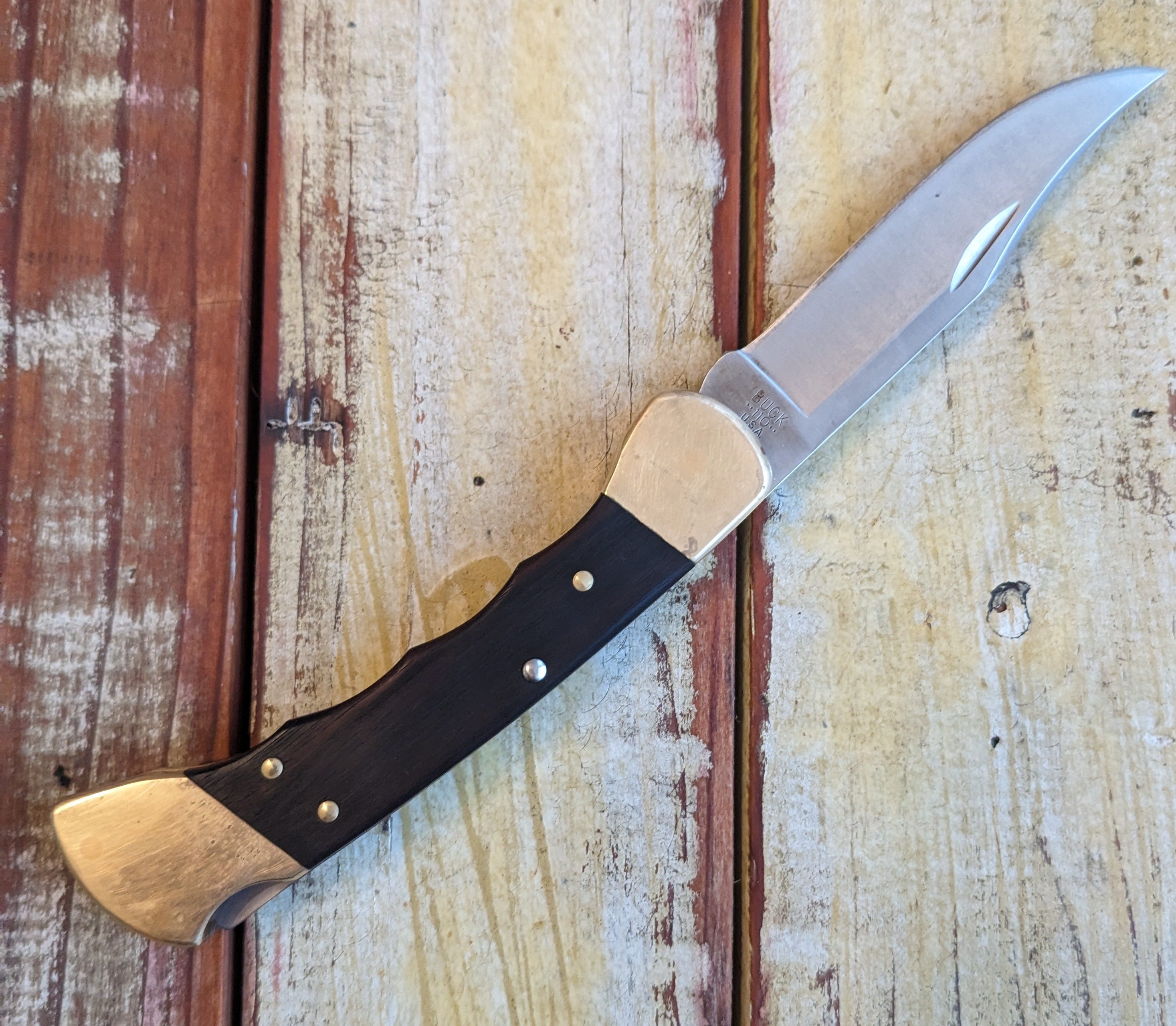
It was mine, from back when I was a kid. I’d not seen this particular knife for quite a few years, I knew that it had to be somewhere, but it was obviously badly misplaced. When we moved into our current house, it somehow ended up in the basement.
When it came upstairs yesterday the brass was pretty darn green from sitting in its leather sheath for so many years, but a bit of elbow grease took care of that in short order.
I had the knife as a kid, because the men of my family all went hunting (in all honesty, much less hunting, much more camping with guns, but you get the idea) each year when I was growing up. If you are going to shoot a deer, well, you need a solid knife. So this was my hunting knife.
What we didn’t have when I was a kid, but have now, is this whole thing called the internet. So as a kid I didn’t know anything about my knife, other than the fact that it is a Buck, and that meant it was awesome.
So, as I was ‘elbow greasing’ it yesterday, I also looked around online.
The date code on the blade shows that it’s a Four Dot, which means that it was manufactured between 1981 and 1986. A bit more looking shows that while the frame is radiused (corners are rounded) the thumb depression around the lock release is not. That solidly means that it was built in 1982. The first year for widespread distribution of the finger groove model, which this is. That also tells me that the knife was made in California, and that the blade steel is 425M.
To me, that’s all rather interesting knowledge to have. It also makes sense, it means that the knife came to me when I was in Junior High School.
The other thing I have to mention is that when my wife brought it upstairs yesterday, it was pretty darn dull. I know why that was. When she found it yesterday, she also found the Arkansas Oilstone I used to sharpen it with. I remember, sharpening that thing was a job. It didn’t sharpen easily, one would sit there for a long time creating a good edge.
I looked at that old Oilstone, put it with my others, and proceeded to put an excellent edge on the knife in minutes with my modern diamond and ceramic stones. To be honest, with the modern stones it took almost no time or effort at all.
I think that there’s a lesson in that.
A lesson beyond the fact that our tools tend to grow better over time.
My good friend VW Clayton often talks about “Iron Sharpening Iron” and the fact that Freemasonry has helped him grow because of the ‘Iron’ he has encountered when dealing with other Masons whom he admires. ‘Admires’ here is key, for we will not improve ourselves if we are sharpening ourselves against defective men, men whom we can’t admire.
And I really think that’s true.
I have a regular reader here on Emeth whom I don’t know too much beyond our written interactions (I did have the honor of meeting him, but only a single time.)
The thing is, he regularly challenges me and my thinking. He’s not afraid to tell me when he disagrees with something I’ve written, and his reasons for that disagreement.
That is really valuable to me.
Because as my friend VW Clayton so often says, ‘Iron Sharpens Iron.’
I think, and sometimes this other fellow pushes against my thinking, and because of that my own thoughts become sharper. Maybe not materially different, but certainly sharper.
That, I believe, has to be one of the great benefits of Freemasonry.
When we become active in a Lodge we become surrounded by a very diverse group of men. Men of different ages, of different work and life experiences. Men of different faith traditions and political leanings. Men of different professions and income levels.
By its very nature, this will lead to challenge, the vast majority of the time, positive challenge. And that makes us stronger. It helps to lead us down the pathway towards wisdom.

Measure twice, cut once. The benefit of multiple perspectives is the insight that they offer. The lived hardships and experiences that might be mitigated or avoided with the right counsel. The successes that might lead to unexpected outcomes with the right timing or vision.
Great topic!
Once again, I was transported back in time by your writing. When I saw the picture of the knife, I immediately recognized the finger groove model as newer than my Model 110. I purchased mine in 1968 when I was working for Boeing on the first 747s, before enlisting in the service. The guys on my crew were impressed with my Buck and soon they all had one. In a discussion with one of my coworkers the question of the quality of the steel came up. One of our inspectors settled the matter by taking my knife and putting it on the Rockwell Hardness Tester in the QC Lab. Yep, sure enough it registered on the "C" scale as the proper steel. I carried that knife when I was in Vietnam and also still have the Arkansas oilstone, I used to sharpen it.